10 Questions Your Infection Control Coordinator Should Ask Any Linen Vendor
A practical checklist for healthcare facilities evaluating commercial laundry partners.
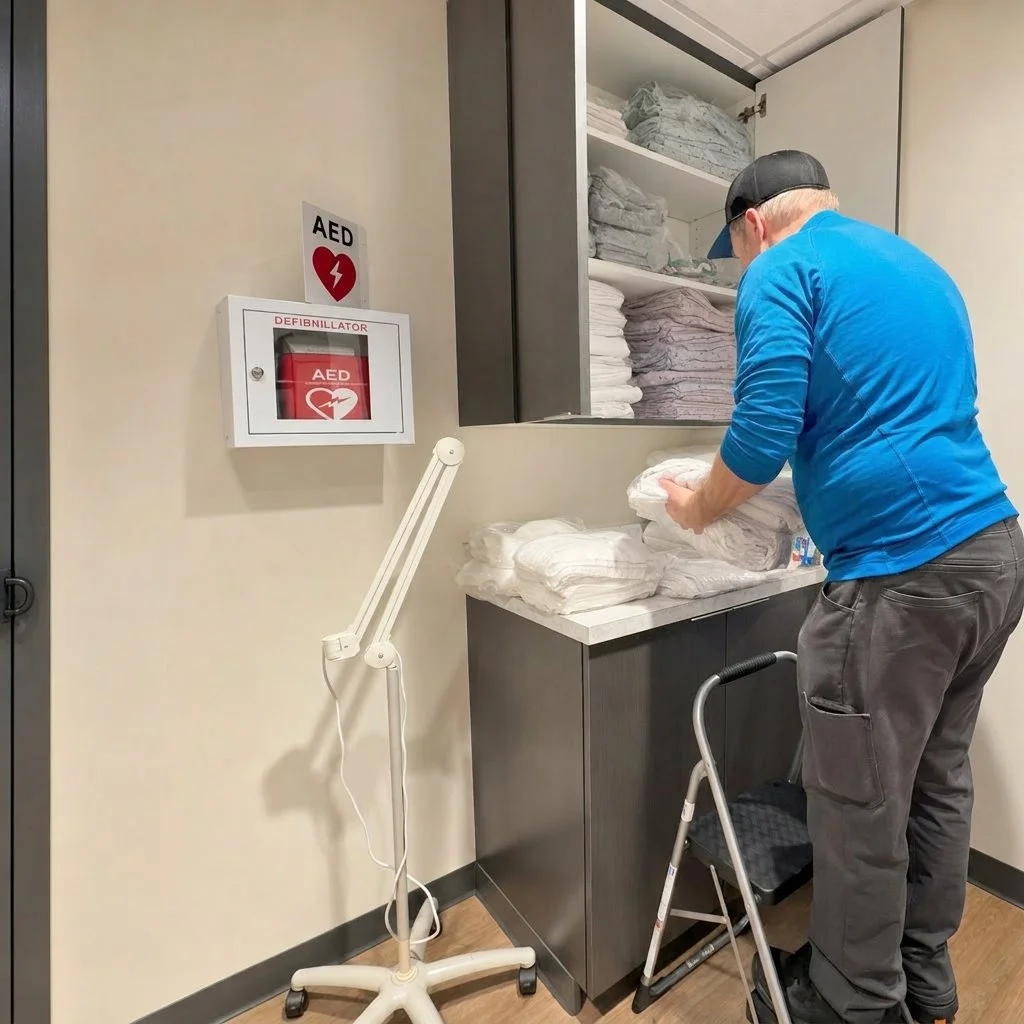
A New System customer service representative stocking a Portland, Oregon medical clinic with fresh sanitary linens.
When a linen vendor walks into a healthcare facility, the conversation usually starts with price per pound and delivery frequency. Those numbers matter, but they are not where infection control coordinators should spend their time.
The vendor handling your scrubs, gowns, sheets, and surgical towels is part of your infection control chain. A weak link in that chain shows up later, in places no one wants it to: inspection findings, patient outcomes, staff exposure incidents.
Below are ten questions worth asking before you sign anything. Bring them to the next vendor meeting. If a vendor cannot answer them clearly, that is your answer.
1. What temperatures and chemistries do you use, and at what stage?
Healthcare wash cycles are not a single event. They are a sequence of stages, each doing different work. A credible vendor should be able to walk you through their cycle: initial wash temperature, detergent and alkali injection and the pH it reaches, bleach concentration and dwell time, rinse temperatures, neutralization, and final extraction. Vague answers about “hot water and strong detergent” are a red flag. Specifics are not proprietary. They are the floor of the conversation.
2. How do you document that wash cycles met spec on the day my linens were processed?
Running a compliant cycle once is not the same as running it every load, every day. Ask whether wash parameters are logged automatically, how long those logs are retained, and whether they can be produced if a regulator or your own infection control committee asks for them. Documentation that exists only when someone goes looking for it is not really documentation.
3. How are clean and soiled linens separated in transport?
This is one of the most common gaps in healthcare laundry programs and one of the easiest to verify. Clean and soiled linens should never share unprotected space, on a truck or anywhere else. Ask specifically how separation is maintained on the route vehicle, what containment is used for soiled items, and what happens when both pickup and delivery occur at the same stop.
4. What chain of custody documentation do you maintain?
Every handoff is a point where something can go wrong, and a point where you may need a record later. Who picked up the soiled linens. Who logged them in at the plant. Who pulled them off the line clean. Who loaded the route truck. Who delivered them back to your facility. A vendor that cannot describe this clearly is a vendor whose chain has gaps in it.
5. What inventory tracking do you use, and how accurate is it?
Inventory tracking is not just an operational nicety. In a clinical environment, it is part of how you maintain par levels, identify items that need to be retired, and document where a specific garment has been. RFID tracking with high accuracy is now standard among serious commercial laundry operations. Ask what the vendor uses and what their measured accuracy rate is. “We count carefully” is not an answer.
6. Can my infection control coordinator tour your facility and review your protocols?
This is a pressure test more than a logistics question. Vendors who run a clean process welcome the audit. Vendors who do not will find reasons to delay, restrict, or redirect you to documents instead of the floor. You do not have to take every tour you are offered, but you should know which kind of vendor you are working with.
7. How do you handle accreditation and what standards do you operate to?
HLAC accreditation is one signal, but it is not the only one, and the absence of a specific certification is not the same as the absence of compliant process. The right framing is broader: what standards does the vendor operate to, how is compliance with those standards documented, and how is it verified. A vendor that meets or exceeds HLAC protocols and can show you the documentation is making a stronger statement than one with a certificate and a thin process behind it.
Ask for the protocols. Read them. Compare them to your own infection control policies. The match matters more than the credential.
8. How quickly can you respond when something goes wrong?
Linen problems in a clinical setting are not abstract. A missed delivery means a clinic running below par levels. A contamination concern means a conversation that needs to happen today, not next week. Ask the vendor what their response time commitment is, who you actually reach when you call, and what authority that person has to fix things. “Within 24 hours” from a local representative is a different commitment than a ticket queued through a national call center.
9. How do you handle exposure incidents and recall situations?
If a contamination concern surfaces, what is the vendor’s process? Can they identify which loads were affected. Can they segregate and reprocess. Can they communicate clearly and quickly to your team. This is the question that separates vendors who have thought about clinical environments from vendors who are running a commercial laundry that happens to have healthcare accounts.
10. Who specifically will be handling our account?
Ask for names. The route driver. The local service representative. The person you call when something is off. Consistency in those roles is one of the best predictors of how a linen program will actually perform over time. A driver who has been on the same route for years knows your facility, your schedule, and what matters to you. That kind of continuity is hard to put a price on, and it is something national providers often cannot match at the local level.
A note on what this list is for-
These ten questions are not designed to favor any particular vendor. They are designed to surface the things that actually matter once a contract is signed and the trucks start running. Most vendors can produce a glossy proposal. Fewer can answer all ten of these clearly.
If you are evaluating linen partners for a clinic, dental practice, specialty facility, or small hospital system in the Pacific Northwest, we welcome these questions. Our team will walk you through our wash cycle, our documentation, our transport protocols, and our chain of custody. We will arrange a facility visit if that is useful. And we will introduce you to the local representative and driver who would be assigned to your account, by name.
New System Laundry
Family-owned commercial linen and uniform service. Serving healthcare facilities across Oregon, Washington, and Idaho.
800-958-6920 · newsystemlaundry.com/healthcare-catalog